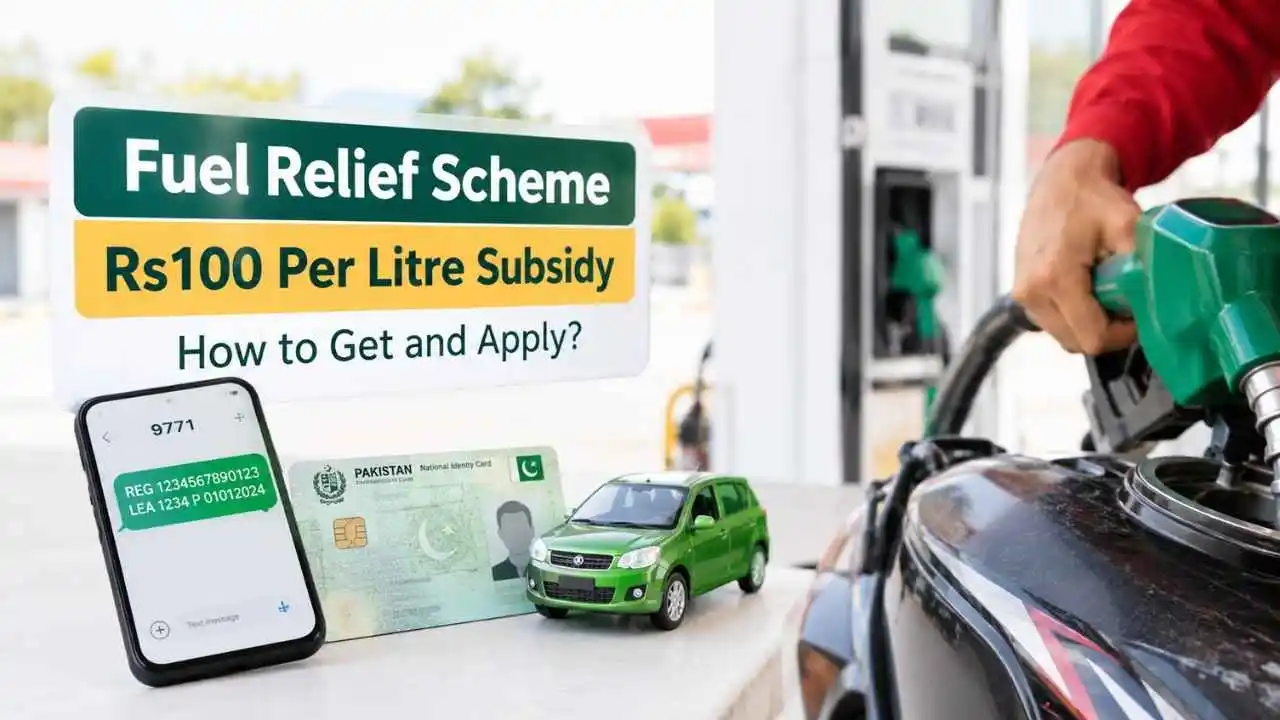
The government has introduced a new fuel relief scheme to provide financial support to people affected by the recent increase in petrol prices. Under the programme, eligible motorcycle, rickshaw, Qingqi and small-car users can receive a Rs100 per litre petrol subsidy on a limited monthly fuel quota.
For motorcycle and three-wheeler users, the relief is available on up to 20 litres of petrol per month, which can reduce their monthly fuel expense by as much as Rs2,000. Eligible vehicles with engines of up to 800cc can receive the same Rs100-per-litre relief on up to 30 litres, offering savings of up to Rs3,000 per month.
The programme has been announced by Prime Minister Shehbaz Sharif in response to rising international oil prices and their impact on consumers in Pakistan. Registration is being carried out through SMS, making it possible for eligible vehicle owners to apply without visiting a government office.
Fuel Relief Scheme – Highlights
The new petrol relief programme provides a Rs100-per-litre subsidy to eligible users of smaller vehicles.
The key points are:
- Relief: Rs100 per litre
- Motorcycles: Up to 20 litres per month
- Rickshaws: Up to 20 litres per month
- Eligible two- and three-wheelers: Up to 20 litres per month
- Cars up to 800cc: Up to 30 litres per month
- Maximum motorcycle/three-wheeler relief: Rs2,000 per month
- Maximum small-car relief: Rs3,000 per month
- Registration SMS: Send the required details to 9771
- Token SMS: Send TOK to 9771
- Motorcycle/rickshaw token quantity: 5 litres
- Eligible car token quantity: 10 litres
- Registration requirement: Valid CNIC, own-name SIM and verified vehicle registration details
The programme is being introduced to provide some immediate relief to people who rely heavily on motorcycles, rickshaws, Qingqi vehicles and small cars amid higher fuel costs.
What is the Fuel Relief Scheme?
The PM Fuel Relief Scheme is a government assistance programme designed to reduce the impact of higher petrol prices on people who depend on smaller vehicles for transportation and daily work.
Through the scheme, the government will provide Rs100 relief on every eligible litre of petrol purchased within the applicant’s monthly quota.
The programme primarily targets:
- Motorcycles
- Rickshaws
- Qingqi and other three-wheelers
- Other eligible two-wheelers
- Small cars with engines up to 800cc
The amount of petrol covered by the relief depends on the type of vehicle. Two- and three-wheeler users can receive the subsidy on up to 20 litres each month, while eligible small-car owners can claim it on up to 30 litres.
How much petrol subsidy can you get?
The maximum benefit depends on your vehicle category.
| Vehicle category | Monthly petrol quota | Relief per litre | Maximum monthly relief |
|---|---|---|---|
| Motorcycle | 20 litres | Rs100 | Rs2,000 |
| Rickshaw | 20 litres | Rs100 | Rs2,000 |
| Qingqi/other eligible three-wheelers | 20 litres | Rs100 | Rs2,000 |
| Small car up to 800cc | 30 litres | Rs100 | Rs3,000 |
For example, if a motorcycle owner uses the complete 20-litre monthly quota, the total relief would be:
20 litres × Rs100 = Rs2,000
Similarly, an eligible 800cc or smaller car using the full 30-litre quota can receive:
30 litres × Rs100 = Rs3,000
The subsidy does not mean that the government will provide unlimited petrol at a reduced price. The Rs100-per-litre relief is restricted to the specified monthly limit.
Who is eligible for the Rs100 petrol subsidy?
The fuel relief programme is aimed at owners and users of smaller vehicles that fall within the categories specified by the government.
Motorcycle users
Motorcycle owners are eligible for a Rs100-per-litre relief on up to 20 litres of petrol per month.
If the complete quota is used, the maximum monthly saving is Rs2,000.
Rickshaw owners
Eligible rickshaw users can also receive the subsidy on up to 20 litres of petrol per month.
The maximum possible relief for this category is therefore Rs2,000 per month.
Qingqi and other three-wheelers
Qingqi and other qualifying two- and three-wheelers are included in the programme. Their monthly relief limit is also 20 litres, with Rs100 relief provided per litre.
Cars up to 800cc
Owners of vehicles with an engine capacity of up to 800cc can receive the subsidy on up to 30 litres of petrol per month.
This category can receive a maximum monthly benefit of Rs3,000.
The government information for the programme includes small cars such as the Suzuki Mehran, Suzuki Alto and Suzuki Bolan among the types of vehicles covered by the scheme.
What are the requirements for registration?
Applicants need to provide information that allows the government to verify both their identity and vehicle.
The main requirements include:
- A valid Computerised National Identity Card (CNIC)
- A SIM registered in the applicant’s own name
- Vehicle registration information
- Vehicle registration details matching the relevant provincial Excise Department records
This verification is important because the fuel relief is linked to the applicant and the registered vehicle.
Before sending the registration SMS, applicants should therefore make sure that their CNIC and mobile SIM information is correct and that their vehicle registration details are available in the relevant Excise Department records.
How to register for the Fuel Relief Scheme through SMS
The registration process is being conducted through SMS.
Applicants need to send their vehicle and personal information in the prescribed format to 9771.
Step 1: Send the registration SMS
Type the following format:
REG CNIC Plate No Province Code Registration Date
Then send the message to:
9771
The registration date must be entered in the required DDMMYYYY format.
For example, if the vehicle was registered on 5 August 2024, the date should be entered as:
05082024
Applicants should enter their own CNIC and vehicle registration information rather than copying the example.
Province codes for fuel subsidy registration
A province or administrative-area code must also be included in the registration SMS.
The codes are:
| Area | Code |
|---|---|
| Islamabad | I |
| Azad Jammu and Kashmir | A |
| Gilgit-Baltistan | G |
| Sindh | S |
| Punjab | P |
| Khyber Pakhtunkhwa | K |
| Balochistan | B |
Make sure you use the code corresponding to the area where the vehicle is registered.
What happens after registration?
After sending the registration SMS, the information will be checked against the relevant records.
If the registration is successful, the applicant will receive a confirmation SMS.
Applicants should keep this confirmation message because it indicates that their registration request has been successfully processed.
If the registration does not go through, check the CNIC, registration number, province code and registration date before trying again.
How to get the petrol subsidy token
Registration alone does not mean you can immediately receive subsidised petrol.
After successful registration, eligible users need to obtain a fuel-relief token before purchasing petrol under the programme.
Step 2: Send TOK to 9771
Before going to a petrol station, send:
TOK
to:
9771
The system will issue a fuel-relief token to eligible registered users.
The token system divides the monthly fuel benefit into smaller purchases.
According to Federal IT Minister Shaza Fatima, motorcycle and rickshaw users will receive relief on five litres at a time, while eligible car users can receive relief on 10 litres per token.
This means the entire monthly quota does not necessarily have to be claimed in a single transaction.
How to buy petrol at the subsidised rate
Once you receive your fuel-relief token, you can go to a participating petrol station.
Step 3: Show the token at the petrol station
Present the SMS token at the petrol station when purchasing petrol.
The applicable Rs100-per-litre relief will be deducted from the eligible petrol purchase.
For example, if you are an eligible motorcycle user and receive a token for five litres, the applicable relief would be:
5 × Rs100 = Rs500
For an eligible small car receiving a 10-litre token, the relief would be:
10 × Rs100 = Rs1,000
The benefit remains subject to the applicant’s remaining monthly quota.
When will the Fuel Relief Scheme start?
The rollout is taking place in phases.
The scheme is scheduled to begin in Islamabad from midnight between September 14 and September 15.
It will then be expanded across Pakistan, including Azad Jammu and Kashmir and Gilgit-Baltistan, from midnight between September 16 and September 17.
Registration for the programme opened on Sunday, while the government has said that additional information will be shared through an awareness campaign.
Is the Rs100 subsidy available on unlimited petrol?
No. The Rs100-per-litre relief is subject to a monthly limit.
Motorcycle, rickshaw and eligible two- and three-wheeler users can receive the relief on a maximum of 20 litres per month.
Eligible cars with engines up to 800cc can receive the relief on a maximum of 30 litres per month.
Therefore, the maximum benefit is:
- Rs2,000 per month for eligible motorcycles, rickshaws and other qualifying two- and three-wheelers
- Rs3,000 per month for eligible cars up to 800cc
Once the monthly subsidised quota has been used, additional petrol purchases are not covered by the Rs100-per-litre relief.
How the fuel relief token system works
The process can be understood in three simple stages:
1. Register
Send your vehicle and CNIC information using the required format to 9771.
2. Get a token
After successful registration, send TOK to 9771 before purchasing subsidised petrol.
3. Purchase petrol
Show the token at the petrol station and receive the applicable Rs100-per-litre relief on the eligible quantity.
This system is intended to allow registered beneficiaries to use their monthly quota without having to complete a separate application every time they need petrol.
Example of the subsidy for a motorcycle user
Suppose a motorcycle owner is registered under the scheme and uses the full 20-litre monthly quota.
The calculation would be:
20 litres × Rs100 relief = Rs2,000
If the benefit is provided in five-litre transactions, the applicant could potentially use:
5 litres + 5 litres + 5 litres + 5 litres = 20 litres
Each five-litre transaction represents Rs500 in relief.
The actual use of the quota depends on the programme’s token and transaction rules.
Example of the subsidy for an eligible small car
Consider an owner of an eligible car with an engine capacity of 800cc or below.
The monthly quota is up to 30 litres.
The maximum relief would be:
30 litres × Rs100 = Rs3,000
If fuel-relief tokens are issued in 10-litre quantities for eligible cars, the monthly quota could correspond to three 10-litre subsidised transactions.
Again, the applicant must remain within the monthly limit.
Important things to check before registration
Before sending the SMS to 9771, applicants should carefully check their information.
Make sure:
- Your CNIC is valid.
- The SIM you are using is registered in your name.
- Your vehicle registration number is entered correctly.
- The vehicle registration date is correct.
- The registration date follows DDMMYYYY format.
- You select the correct province or area code.
- Your vehicle information matches the relevant Excise Department records.
A small error in the registration details can prevent the system from matching your application with the official vehicle record.
What should you do after receiving the confirmation SMS?
Once your registration is confirmed, you do not need to repeat the registration process every time you purchase petrol.
Instead, when you want to use the relief, request a token by sending:
TOK
to 9771.
Wait for the token SMS and present it at the petrol station when purchasing the eligible amount of petrol.
It is advisable to keep the token message available on your phone until the transaction is completed.
Applicants should enter their registration information carefully and wait for confirmation before requesting a fuel-relief token.

I’m a freelance content writer with hands-on experience. I specialize in topics like online earning, finance, and digital growth, sharing practical insights, real strategies, and up-to-date information. My goal is to create helpful, trustworthy content that people actually benefit from.


