Punjab is set to introduce a revised school curriculum designed to reduce students’ academic burden and move classroom learning away from excessive memorisation. Chief Minister Maryam Nawaz has approved the new curriculum after a meeting in Lahore where education officials presented the proposed reforms.
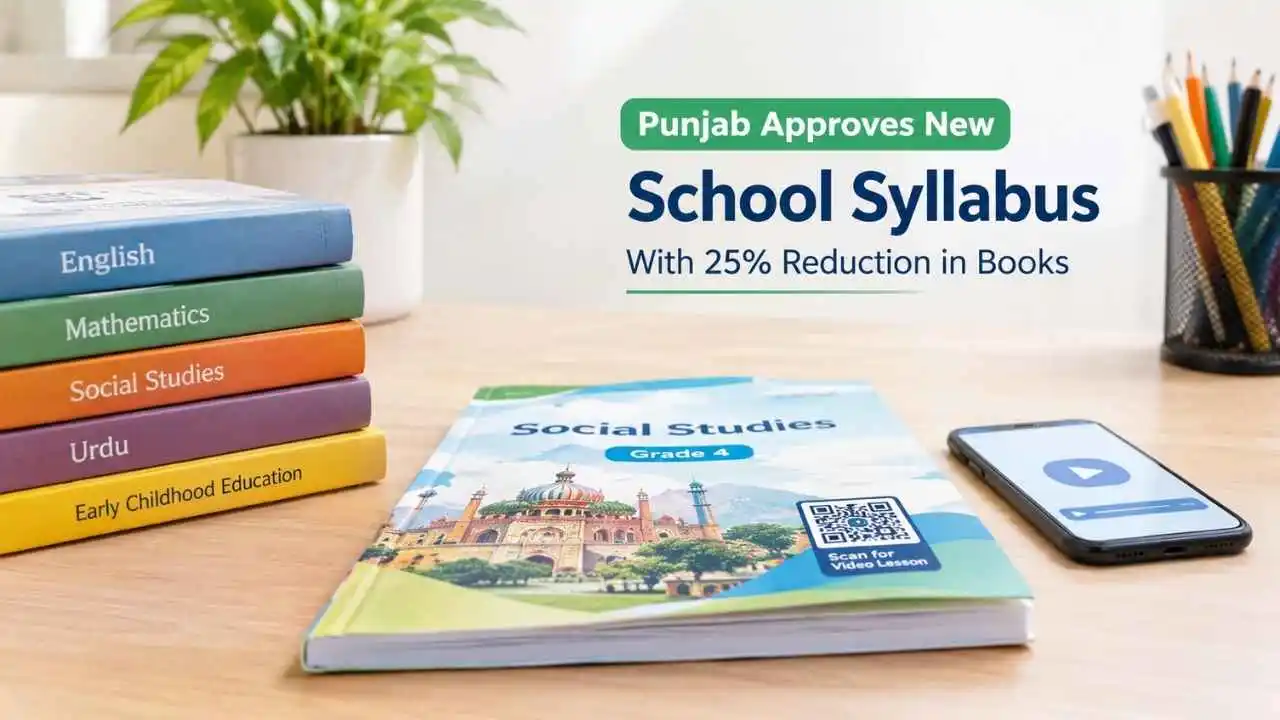
The revised curriculum focuses on making school learning more practical, manageable and concept-based. Under the plan, the volume of textbooks will be reduced by 25 percent, while digital resources such as video lessons will be connected to textbooks through QR codes.
The initial curriculum reforms cover English, Mathematics, Social Studies, Urdu and Early Childhood Care and Education (ECCE). According to officials, the new books for Montessori to Grade 5 are expected to be available for the academic session beginning in April 2027.
25% Reduction in Textbook Volume
One of the major changes in the new Punjab school curriculum is the reduction in textbook volume.
Officials said the new books will have around 25 percent less content by volume, including a reduction in the number of pages. The objective is to make textbooks easier for students to handle while reducing unnecessary academic load.
The reform is also intended to give teachers more time to focus on understanding concepts instead of trying to complete large amounts of textbook material.
According to PECTAA officials, the revised curriculum places greater emphasis on learning outcomes rather than memorising information.
QR Codes Will Connect Textbooks With Video Lessons
The new textbooks will also include QR codes to provide students with additional digital learning material.
Students will be able to scan the QR codes and access video lessons related to topics covered in their books. This approach is intended to connect traditional textbooks with digital learning resources.
The move could also give students another way to understand difficult concepts instead of relying entirely on written explanations inside textbooks.
New Curriculum to Focus on Concept-Based Learning
The Punjab government is also shifting its education approach from rote learning toward conceptual understanding.
PECTAA has previously worked on curriculum reforms aimed at reducing unnecessary learning outcomes and removing duplication from the primary-level curriculum. The objective is to help students develop understanding, critical thinking and practical learning skills rather than simply memorising large amounts of information.
The latest curriculum covers key subjects including English, Mathematics, Social Studies and Urdu, along with Early Childhood Care and Education.
PECTAA CEO Musa Ali Bukhari told Dawn that the new ECCE-to-Grade-5 curriculum was also sent to Cambridge International Education for assessment and comparison with international curricula. The final content is expected in December 2026, followed by textbook printing from January 2027.
AI Curriculum Planned From Grade 1 to Grade 12
Artificial intelligence is another major part of Punjab’s planned education reforms.
Chief Minister Maryam Nawaz has directed officials to finalise an AI curriculum for students from Grade 1 to Grade 12. The plan is intended to introduce students to modern technology from an early stage and gradually develop their digital skills.
The AI curriculum is expected to be supported by computer laboratories and other digital facilities in schools. Punjab has already taken steps toward introducing AI education, with PECTAA rolling out an AI curriculum framework earlier in 2026 covering areas such as computing, data science, machine learning, robotics and ethical AI.
The proposed approach for younger students also includes areas such as digital literacy, computational thinking, robotics and responsible use of AI.
Teachers to Receive Training on the New Syllabus
The curriculum reforms will also involve changes in teacher training.
Saturdays are planned to be dedicated to teacher training across Punjab. Authors involved in preparing the new textbooks are expected to conduct training sessions so teachers can understand the revised material and teaching approach.
The involvement of textbook authors is intended to help teachers understand how the new curriculum should be delivered in classrooms.
Officials also said that English-language training had already been completed for 35,000 teachers across 31 tehsils in 12 districts.
Mental Health Training for Teachers
The education reforms also include a greater focus on students’ mental health.
The meeting reviewed a proposal to provide mental health training to teachers so they can better recognise and respond to students’ emotional and psychological needs.
The government also considered appointing visiting psychologists in every district. In addition, online counselling facilities for students were proposed as another way to provide support.
These measures are intended to expand the support available to students beyond traditional classroom teaching.
Punjab Moves Toward Ending Corporal Punishment
The meeting also reached an agreement in principle on legislation aimed at eliminating corporal punishment in schools.
Instead of physical punishment, the proposal includes constructive disciplinary measures. A proposal for establishing “discipline corners” in classrooms was also discussed.
Chief Minister Maryam Nawaz said physical violence in schools can have long-term effects on children and called for alternative approaches to maintaining discipline.
When Will the New Punjab School Books Be Available?
The new curriculum is being developed in stages, with the first major implementation covering Montessori to Grade 5.
According to PECTAA officials, the final curriculum content is expected to be completed in December 2026. Textbook printing is planned to begin in January 2027.
The new books are expected to be available for students when the new academic session begins in April 2027.
What the New Punjab Curriculum Means for Students
The revised curriculum represents a broader shift in how students are expected to learn in Punjab’s schools.
Instead of placing heavy emphasis on memorisation and extensive textbook content, the new approach focuses more on understanding, practical learning and digital skills.
Students will also have access to video lessons through QR codes in textbooks, while the planned AI curriculum could introduce technology-related skills from the early grades.
At the same time, teacher training, mental health support, counselling and proposed legislation against corporal punishment are being included as part of the wider education reform programme.
The Punjab government says its broader objective is to build a modern public-school education model with greater attention to AI, digital literacy, laboratories, primary education and improved learning outcomes.

I’m a freelance content writer with hands-on experience. I specialize in topics like online earning, finance, and digital growth, sharing practical insights, real strategies, and up-to-date information. My goal is to create helpful, trustworthy content that people actually benefit from.